
How many restrooms does a marathon or race need?
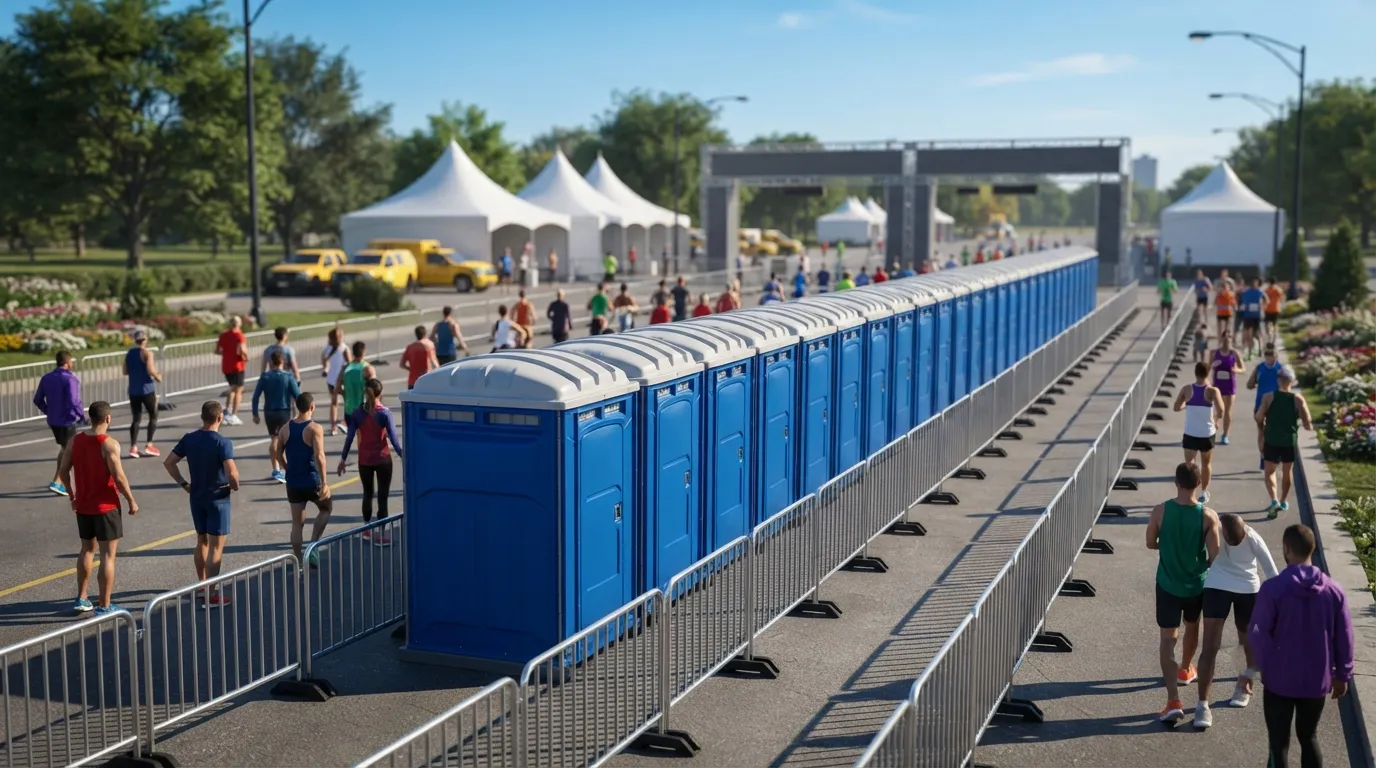
Start with headcount and the shape of your course. A point-to-point race spreads runners thin along the route, so you need restrooms at aid stations, not just the start and finish. A loop course lets you concentrate units at one or two hubs. Our guide to how many porta potties you need walks through the ratio math, but the short version for spectator-heavy events is more units than a construction crew would need for the same headcount, because everyone shows up and leaves inside a two-hour window instead of trickling in over a shift.
For the start corral and finish festival, standard portable restrooms handle the bulk of the demand, and a event-day rate for that unit type runs in line with the pricing shown on our portable restroom rental page. Aid stations further out on the course usually need fewer units each, but more locations. If your race draws a crowd that expects flushable fixtures at a VIP or sponsor tent, a deluxe flushable unit is worth adding near the finish line. Every cluster of standard units needs at least one accessible unit under ADA Standards 213.2, which also requires a 60 inch turning circle inside the unit under ADA Standards 304.3.1. Our ADA accessible porta potty page has the specs if your event insurance or city permit asks for documentation.
Where should restrooms go on a race course?
Restrooms belong wherever runners cluster and wherever a service truck can reach without blocking the course. That means the start line, each aid station, and the finish festival, spaced so no runner has to leave the route to find one. Placement guidance matters more on a race course than almost any other event type, because access has to work for both spectators and the pump truck on turnaround morning.
If your race routes near Redwood City and touches neighboring communities, plan restroom drops for each cluster separately rather than one big bank at the start. Menlo Park sits 6.0 miles southeast of Redwood City, and San Carlos is 6.4 miles west, distances worth knowing if your course crosses jurisdiction lines or if you're comparing porta potty rental in Menlo Park or porta potty rental in San Carlos as backup vendors for a multi-city route. A finish festival near Palo Alto, 12.4 miles southeast, might pull rental units from a different depot than your start line in Redwood City, so tell your vendor about every leg of the course up front.
Timing tents and medical stations often run generators and light towers overnight before race morning. If your event uses a temporary power pole to feed a timing trailer or food vendor, brace it properly: knowing how to brace a temporary power pole matters here: guy it at two points roughly 90 degrees apart from the anticipated load direction, stake the guy lines outside the pedestrian path, and never let the pole rely on the power cord itself for support. A pole that leans under wind load or a bumped cord can drop power to your timing system mid-race, which is a worse problem than a full restroom.
What else does a race site need besides restrooms?
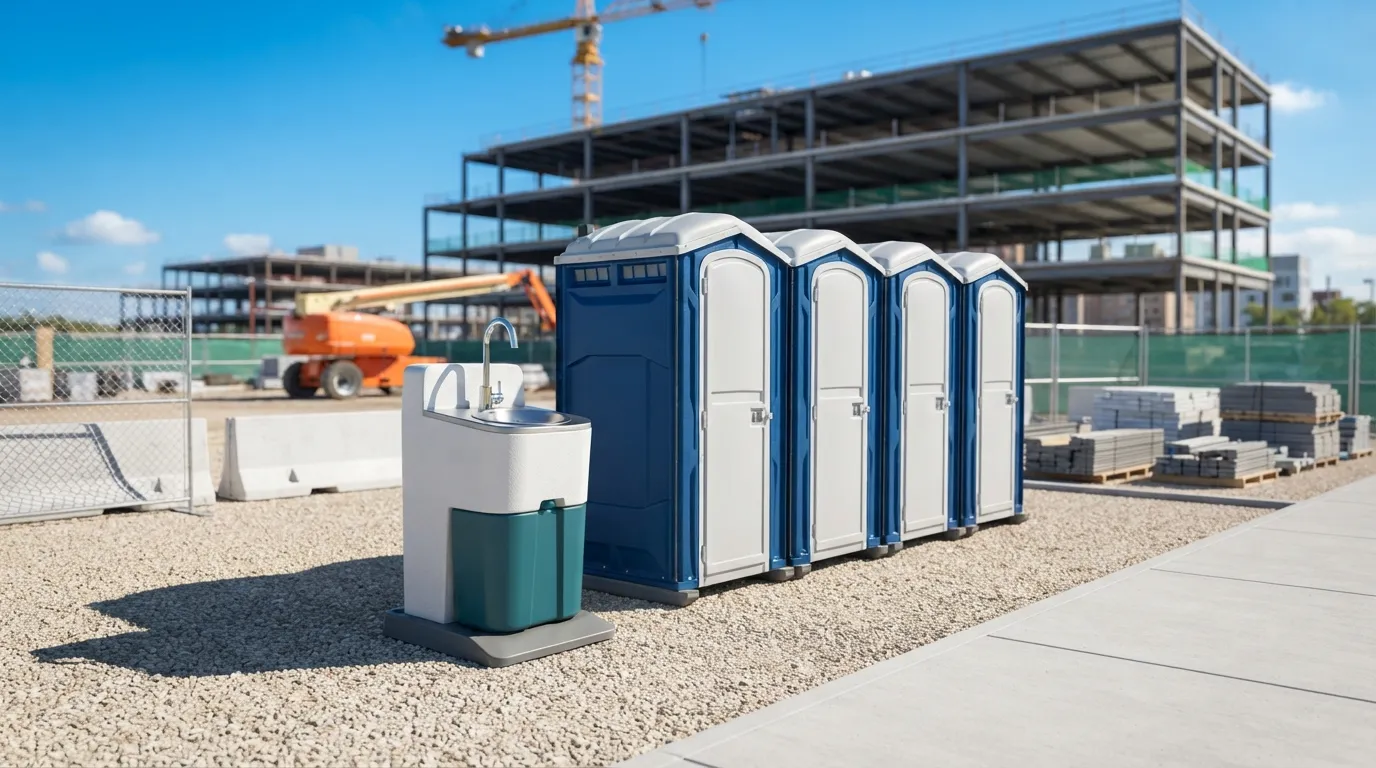
Handwashing, waste removal and crowd barriers round out a race site, and skipping any one of them shows up in the post-event feedback. Aid stations and the finish festival both need handwashing station rental or at minimum a hand sanitizer station, since 29 CFR 1910.141(d)(2) requires soap and towels or a hand drying device at wash stations, not sanitizer alone, if your event is staffed by paid crew under general industry rules.
Finish festivals generate trash fast, so a roll-off dumpster or two near the vendor row keeps the site from looking like a landfill by noon. A 10 yard unit handles most single-day festivals; check dumpster sizes and dimensions if you're unsure which size fits your footprint. Course marshals and barricades along the route should meet ANSI D6.1 per OSHA 1926.202, and crowd control barrier rental covers the finish chute where the crowd tends to surge. If your race includes an expo or packet pickup the day before, a short-run temporary fence rental keeps vendor areas secured overnight. For races that stage in Redwood City and need a full build-out, our construction site services page also covers site setup basics that apply to large festival grounds.
How far in advance should we book restrooms for a race?
Book six to eight weeks out for a race over a few hundred runners, longer if your date lands on a busy fall weekend. Vendors juggle several events on the same day, and course-length placement takes more planning than a single-site rental. Start with a request a quote once your route map is set.
Do we need an ADA-accessible unit at every aid station?
Yes, at least one per cluster. ADA Standards 213.2 requires at least 5 percent of clustered units to be accessible, with a minimum of one, so even a two-unit aid station needs one ADA unit. See our ADA restroom requirements page for full spec details.
Can we get emergency restrooms added the week of the race?
Sometimes, depending on inventory. Call ahead rather than assume. Our emergency porta potty rental page covers rush turnaround, but a race with fixed aid station counts is easier to service if the order is locked early.
What does a race-day restroom rental typically cost?
Event-day standard unit pricing runs higher than a weekday construction rate because of the compressed single-day service window. Check porta potty rental cost for the current range, and compare against a multi-day rental per day rate if your event spans a weekend.
Do we need dumpsters if the venue already has trash cans?
Usually yes, for the volume a race generates. Trash cans overflow within an hour at a finish festival. A dedicated roll-off dumpster or two keeps the finish area clear of overflow through breakdown.
Next step
Get a delivery date
Tell us the address, the dates and the headcount. We size the order and confirm the route.