
Do you need a permit for a porta potty in Redwood City?
Most residential jobs don't need one. If porta potty rental in Redwood City, CA sits on private property, on a driveway, lawn or job site pad, you're generally clear to place it and go. The question changes the moment any part of the unit touches public land: street, curb strip, sidewalk or an alley the city maintains. Redwood City has not published a specific rule we could verify for portable toilet placement in the right of way, so we tell every customer the same thing: call the city and confirm before the truck rolls. That single phone call costs you nothing and saves you a re-delivery fee. This applies whether you're planning a home renovation porta potty setup, an event restroom rental, or a full construction site services package with multiple units. Contractors juggling a temporary power pole permit or a dumpster permit requirements question often find the toilet placement gets folded into the same conversation with the city, so ask about both at once.
Is a dumpster permit different from a porta potty permit?
Yes, and dumpsters trip the permit question more often. A roll-off dumpster rental sitting entirely on your own lot typically doesn't need a permit. The moment it sits on the street, most cities want a permit for a dumpster on the street, and Redwood City is no exception in spirit even though we can't cite a specific ordinance number here without a verified source. A 10 yard dumpster rental or 20 yard dumpster rental needs about 60 feet of straight clearance behind the delivery truck, which matters for street placement decisions since that clearance rarely exists on a narrow residential block. If you're weighing dumpster rental cost against porta potty rental cost for the same job, permit fees for street placement can shift that math, so get the city's answer before you budget. This isn't a Redwood City quirk either. Jersey City dumpster permit rules and Delaware porta potty rental rules follow the same general shape: private property is simple, public right of way requires asking first.
What are the porta potty placement rules on a job site?
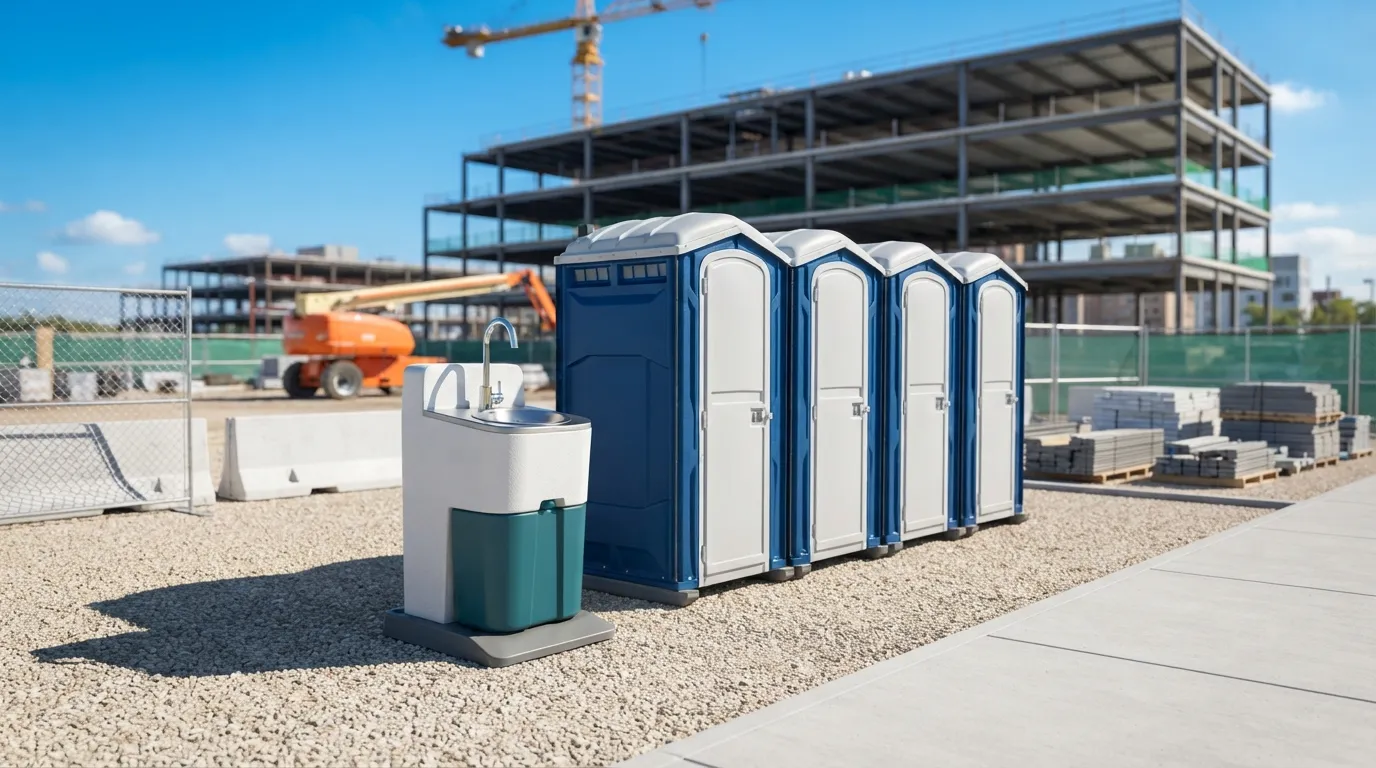
Placement rules mostly come down to access and stability, not paperwork. ADA Standards section 302.1 requires the ground under and around an accessible unit to be stable, firm and slip resistant, which rules out loose gravel or soft turf for an ADA accessible porta potty. ADA Standards section 403.5.1 calls for a 36 inch clear path to the unit, and section 304.3.1 wants a 60 inch turning circle in front of the door. A standard unit runs about 44 by 48 inches on the ground and stands roughly 92 inches tall, so give it clearance from overhead branches and low eaves. OSHA 1926.51(c) sets the worker-to-toilet ratio on construction sites: one unit for 20 workers or fewer, scaling up from there. If you're not sure how many units that means for your crew, the how many porta potties do I need guide walks through the math, and OSHA portable toilet requirements covers the full ratio table. Servicing access matters too. ANSI/PSAI Z4.3 sets a baseline of one service visit per week for up to 10 users over a standard 40 hour week, and the pump truck needs a clear path to reach the tank.
Do handwashing stations or septic setups need separate approval?
Handwashing stations rarely trigger their own permit, but they do carry a compliance rule worth knowing. 29 CFR 1910.141(d)(2) requires soap and towels or a hand drying device at washing facilities; hand sanitizer alone doesn't satisfy it. If your crew is applying paints, coatings, herbicides or insecticides, OSHA 1926.51(f)(1) requires washing facilities for that specific work, which is a separate trigger from general site sanitation. A handwashing station rental or portable sink rental placed on private property alongside your toilets usually rides along with the same delivery, no extra approval needed. Septic work is its own category. A septic pumping service truck accessing a tank on private property doesn't need a street permit unless the truck itself has to park in the right of way to reach it, which is another case where a quick call to Redwood City settles it fast. A typical residential tank gets pumped every 3 to 5 years depending on tank size and household size, and a grease interceptor is pumped once fats, oils, grease and solids hit 25 percent of the liquid depth, per standard grease trap guidance covered in grease trap pumping.
| Situation | Permit likely needed? |
|---|---|
| Unit on private driveway or yard | No |
| Unit on street, curb or sidewalk | Confirm with city |
| Dumpster on private lot | No |
| Dumpster on street | Confirm with city |
| Septic truck on private property | No |
For jobs near San Carlos, 6.4 miles west, or Menlo Park, 6.0 miles southeast, the same rule applies: check the municipality where the unit actually sits, not where your office is. See service areas for coverage details, or start with a request a quote and we'll flag the placement question up front.
Do I need a permit to put a porta potty on my own property?
No, in almost every case. Private driveways, yards and job site pads don't require city approval for a standard delivery. The question only opens up if you want the unit visible from the street or partly on a shared easement, which is worth a quick call to confirm.
Can I put a dumpster on the street in Redwood City?
Sometimes, but you need to ask first. Street placement almost always needs a permit for a dumpster on the street in cities this size, and Redwood City hasn't published a rule we can verify without confirming directly. Call before delivery rather than after a citation.
What happens if I place a unit in the right of way without asking?
You risk a fine or a forced relocation, sometimes on short notice. It's a bigger headache than the phone call would have been. Contractors managing a construction dumpster rental and a toilet on the same tight urban lot run into this most often.
Does a temporary power pole need its own permit?
Likely yes, since it involves an electrical connection and inspection in most jurisdictions. A temporary power pole is a separate approval track from sanitation equipment, and it's worth bundling that conversation with the city alongside your dumpster or toilet placement questions.
How far in advance should I ask the city about placement?
As soon as you know the site layout, ideally a week or more before delivery. That gives time for the city to respond and for us to adjust the delivery plan if the right of way isn't an option.
Next step
Get a delivery date
Tell us the address, the dates and the headcount. We size the order and confirm the route.